Chapter One
Journey of a Solutionist
From a Hydrogen Bomb to a Kansas Farm
Are you ready to raise the zone and create a solution-based world? Our starting point is where my journey, or my tour of life, began. On March 1, 1954, I was born in Paola, Kansas, about 17 hours after the Castle Bravo nuclear blast lit up the South Pacific. It was the largest explosion of a hydrogen bomb by the U.S. in history – 1,000 times greater than the bomb dropped on Hiroshima. It was 2.5 times larger than expected, due to a miscalculation.
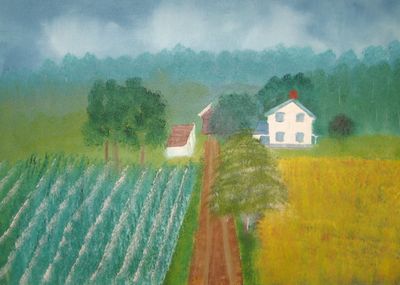
Above is a photo of my late father’s painting of our family farm about one mile outside of Paola. It was a wonderland of learning and adventure. It also taught me a little about nature’s mysteries and magic. Five years on our farm set me on a quest for truth and prepared my life’s mission as a “solutionist”.
Are you a solutionist? That is someone who solves puzzles or problems on any scale. It best describes my life and mission. I would add discoverer of possibilities to that definition. Activists and advocates do vital work in raising awareness concerning a range of problems. My approach is to offer proven and affordable solutions. This chapter shares my journey that led me to write a book about uplifting your life and our world.
Vowing to Solve Global Problems at Age 10
My path of solutionism began in elementary school with a big wake-up call. It happened on a playground – not in class. Kids talked about all kinds of things. One day, a friend walked up to a few of us who were in a conversation. He claimed, "My dad said you’re using only one tenth of your brain." That ignited my anger and sparked my curiosity. It probably had roots in American psychologist William James' view that people rarely achieve more than a small percentage of their full human potential.
Regardless of the validity of that view, it shook me to my core and infuriated me. After my shock settled down, it hit me that if his claim was true, it might explain some terrible things. Those included JFK’s assassination a year before, the Cold War, escalation of the Vietnam War, and maybe even bullying at school.
My rude awakening compelled me to vow two things. First, to develop my full brain. Second, to find solutions for big and little problems in our world and life in general. It seemed simple. Why would a 10-year-old child dare to have such bold goals? I didn’t ask. My path and vision were clear and illuminated. No reason came to mind why these goals were not achievable.
How does one start down those paths? I did what everyone does who has ever achieved anything – I had an intention to do something and committed to it. Those are common steps advised by probably every motivational philosophy. Major marketing campaigns are also built around those same essential principles to promote goods, services, institutions and more.
Starting on My Paths
Those first steps on my paths were challenging. There were no maps or signs, but resources quickly came to my attention. Plato’s Republic was one. Other comments from unexpected sources helped too. Balance in everything seemed important. Mind-body coordination and eating right were part of that.
About that same time in elementary school, I got straight A's and won the most “Blue Ribbons” on field day. I taught myself to do handstands and handsprings. A year later I was elected student council president. However, it became apparent that I could do little to help anyone in my school. It didn’t propel me into politics. Instead, it inspired me to find real solutions in other ways.

Crystallizing a Better Future
Another story in elementary school greatly influenced my life. A friend told me about an unusual group of people. They would find out when lakes or ponds were nearing the point of freezing. They would carefully sneak up to a body of water. With the most delicate touch, one person would place a seed ice crystal into still water. Suddenly, as they expected, the water’s surface started to crystallize. It made a unique crackling sound. The delicate patterns spread in all directions. It must have been thrilling to see and hear that magical phenomenon in nature.
Was that event possible? I didn’t know, but I have seen many opportunities throughout life to inject a tiny crystal of an idea into situations at what turned out to be perfect timing. I believe that such opportunities exist right now around our world. Each could allow huge advances for humanity with the right “crystal” idea. What’s your crystal idea?
Coherent symmetrical designs, like those of crystals, always fascinated me. Following, are scans of some of my drawings from elementary school. A piece of paper, a pin to poke holes, a ruler and some colored pens, were all I used. I believe these images planted seed crystals for writing this book.
Choking on Rocks to Speak Better
I read about Demosthenes, the prominent Greek citizen and orator in ancient Athens. He put a pebble in his mouth and spoke out over the sea to improve his speech. I talked with small objects in my mouth over the parking lot next to our house. Alas, after swallowing or choking on too many rocks, marbles and quarters, I moved on to other ways to develop my full brain.
My attempts included trying a more balanced and healthy diet. That meant primarily one thing to me. I would take some of just about everything in the refrigerator and pile it all between two slices of white bread. The sandwich would be about three inches high. After eating it, I would wash it down with gulps of milk, then carbonated soda, orange juice and Kool-Aid. I drank straight from all the containers. Life seemed balanced! I’m not sure my stomach was. At least my intentions were good. A few years later, I learned about truly healthy habits such as exercise, cleansing my lymphatic system, and growing and eating organic vegetables.
Meditating to Survive Teenage Life
In junior high school, I tried juggling, judo and yoga. They all felt right and good. I also got into mild drugs. That was not good, but I gave into peer pressure and curiosity. In high school, I went to a lecture on Transcendental MeditationTM (TM). The TM teacher said, "Psychologists tell us we use only 5-10% of our mental potential. TM helps to develop the rest of our brain.”
That convinced me to learn TM right away. In my first experience of TM, a huge cloud of stress lifted from me. The natural high that I felt from TM was so much better than cannabis or other drugs, that I immediately lost interest in them. That was my first real enlightening experience on the path to develop my full human potential. I’ve continued my daily practice of TM since then.
Buckminster Fuller’s Influence
Buckminster Fuller was another great inspiration. The story I remember about Bucky Fuller is that he was despondent about his young daughter’s death and considered ending his life in Lake Michigan. As he stood there in deep water and deeper sorrow, contemplating the last moments of his life, he pondered a big question, “How much can one person achieve?” His curiosity compelled him to walk out of the lake.
Fuller went on to become a legendary inventor, futurist, and visionary. He inspired millions with his futuristic, and yet, practical solutions. His “Dymaxion Car”, geodesic domes, floating cities, and “Spaceship Earth” philosophy, were legendary.
His extensive research and engineering concluded that it was possible to make war obsolete and provide everyone on Earth with an extremely high quality of life by converting the world’s deadly “weaponry” to “livingry”.
“You Should Be Called Blue Cloud”
Vivid dreams have been common for me since childhood. Some were lucid, in that I seemed to be in control. I could explain things during a dream as clearly as if in waking state. A few dreams have shown me things that did not exist at the time or had not yet happened. They then occurred later in remarkable matching details.
One particular dream, in 2009, was both symbolic and prophetic. It triggered my renewed promotion of one of the most extraordinary solutions I know. It was powerful in its impact and played a big part in inspiring me to write this book.
In the dream, I was on a public bus going north on Federal Boulevard in Denver. I’ve never taken that route on a bus. The only people I saw on the bus were three Native American children on seats across the aisle and me. They looked at me curiously for a short time. One of them asked my name. I answered "Jeffrey." They looked at each other in a disapproving way. Then one of them said, "That is not a very good name for you. You should be called Blue Cloud.” That simple response surprised me. Why would they call me that? I had never heard the name of Blue Cloud before. We then all sat quietly without talking.
Our bus stopped one block before the major intersection of West Alameda Avenue and Federal Boulevard. It’s next to what is now the Far East Asian shopping center. We all got off the bus. They knew where to go. I followed them out of curiosity. We walked west along a side street in an area that my family drove through every Sunday to a Lutheran church. It was three blocks west of where we got off the bus.
We arrived where the church would have been. However, the street intersection, and nearby area, was instead a pristine, grassy, open clearing surrounded by pine trees, as I would expect to see in the Black Hills of South Dakota. In the clearing were four Native American adults. Two of them were 30-40 feet in front of me. Two were about twenty feet to my left.
Close in front of me was a row of at least twelve colorful, closed, egg-shaped baskets. They had traditional Native American designs on what looked like large Easter eggs. Colors were vibrant and their designs were intricate. The baskets laid on top of wooden tables about four feet high. It was a wonderful showcase of Native American artistry. There was no verbal conversation with those adults. Then, through what seemed to be both intuition and clear telepathic communication, my heart sank in deep sadness.
The row of baskets was a group of papooses. One definition of papoose is a backpack or basket to carry a Native American child. Another definition of papoose is the child itself. The raised tables, or platforms, were for cremation of the children. Telepathically, the adults told me that the infants had died from a “harsh winter”. Grief overwhelmed me, and I could only weep from that image. In our present time, we think of harsh winters and extreme weather events from human-caused climate change.
Vision of Preventable Disaster
Seeing my deep sadness, they quickly explained that it was not a vision of only one possibility. They said the harsh winter had not happened yet and it did not need to happen. They said there were things I could do to prevent it. Naturally, I was relieved and yet confused. What could I do? What could anyone else do? I woke up, literally and metaphorically. Immediately, I went to my desk and searched the Internet for “Blue Cloud”. I found a few references. One said it was a cloud containing nourishing rain. To me, that meant balance in nature and the good fortune of rain.
That dream strongly affected my plans going forward. I looked for clues about what I could do to prevent the harsh winter. How could I help avoid the tragic deaths of such precious children in those beautiful baskets? Was it a premonition about children all over our world? Months later, a detail finally struck me.
We got off the bus at South Federal Boulevard and West Dakota Avenue. Symbolically, I had gotten off the government (Federal) bus and walked with the Native American (Dakota) children in the pristine environment that they regard as sacred. I kept searching for any means to prevent that harsh winter, concerned that it was not just a dozen children, but also much of human life.

Four Feet of Hail Woke Me Up
Jumping to June 2015, another shockwave hit me. This time, it was in my waking state of real life. A major hailstorm hit Denver on June 4. It happened to be "bike-to-work" day. I was at home, frantically protecting my amazing organic strawberries just as the intense storm began. The next day, the Denver Post reported:
“Denver block buried under 4 feet of hail”
The article stated that the affected area was between Dakota Avenue and Alaska Street. I was awestruck. That area along South Irving Street was exactly where I stood with the Native American adults and children in my dream six years earlier. The message was clear. It was time to speed up promoting a breakthrough global solution to climate change.
An Air Pollution Solution for the Rich and Famous
It was still June. Many top “A-list” celebrities had made headlines for supporting different campaigns about air pollution and potentially catastrophic effects of climate change. It was time to inform them of a unique technology that had reduced Los Angeles air pollution at least 40% over a three-month period in 1990!
One month after the rare hail pile-up in Denver, I sent a letter to over 50 of these A-list stars. It was a long shot, as you never know if your letter will get past the filter of agents, publicists, and other gatekeepers. Only about five of the letters came back to me. However, no one replied. It didn’t matter by that time because my priorities suddenly shifted.
My dear mother, whom I was caring for, was experiencing worse respiratory health problems. That’s a common effect of high levels of ozone. However, all I could do was to make her as comfortable as possible in her remaining days. She finally passed away that summer in August. It reinforced my commitment to share a solution to air pollution and its related health disorders.
Robert Redford’s Reply
In September 2015, I received a kind and appreciative letter from Mr. Redford’s assistant. He said that Redford had too much on his plate to get involved in what I proposed. So, it was clear that I should do myself, what my proposal asked of celebrities.
In October 2015, I wanted to replicate in Denver, the L.A. air quality study done by the inventor in 1990. However, he wanted to finish some scientific explanations for his technology. So, it seemed like a good time for me to write my first non-fiction book: POWER UP – How to Create a Solution-Based World in 100 Days.
Now, with revised content and new name of RAISE the ZONE, I’ll add my favorite full quotation about commitment. That’s a big theme throughout our tour. The following quotation is from the famous explorer and Mt. Everest climber, William H. Murray:
- This may sound too simple but is great in consequence. Until one is committed, there is hesitancy, the chance to draw back, always ineffectiveness. Concerning all acts of initiative (and creation), there is one elementary truth, the ignorance of which kills countless ideas and splendid plans: that the moment one definitely commits oneself, then providence moves too. A whole stream of events issues from the decision, raising in one’s favor all manner of unforeseen incidents, meetings and material assistance, which no man could have dreamt would have come his way. I learned a deep respect for one of Goethe’s couplets:
Whatever you can do or dream, you can begin it. Boldness has genius, power and magic in it!

The Magic of Commitment – A Surreal Story
As a warm-up lap before our main tour starts, here’s one story that illustrates the magical power of commitment. It also shows one of the first times when backroom politics directly influenced my life. During high school, I envisioned my future as an architect. I didn’t go immediately into college for that but instead became a teacher of Transcendental Meditation. Still, solar architecture and urban planning remained a strong interest.
Then, in 1979, I unexpectedly met Colorado’s renowned solar architect, Richard Crowther, at his new passive solar home. We introduced ourselves and shared our interests. He wanted to learn about Transcendental Meditation. I wanted to learn about architecture. Subsequently, we made an agreement that he would take me on as an apprentice and assistant property manager.
My wife at that time, and I, were to live in one of the units of his new home and receive a good salary. It was a dream job. However, before we moved in, we were called to attend a World Peace Assembly due to the tense relations between the U.S. and U.S.S.R. The situation was dire enough, that all of the conference attendees were urged to continue in a program for many more months. So, I had to withdraw from the agreement.
That did not end my interest in architecture. In 1995, I worked at a construction company that was introducing Vastu Shastra, also known as Sthapatya Veda, into building and town design. It’s the ancient science of building in accord with natural law. Then, my Italian friend in Rome asked me if I could organize a team for a “by-invitation-only” international architectural design competition. I said, “Sure! I can do that”. I committed.
I knew a few contacts from my job. The design competition was for redeveloping the Piazza dei Navigatori, in the EUR, south of Rome on Via Christoforo Columbo. The subject six-acre property was owned by my friend and his stepbrother, a construction engineer. It was the largest undeveloped site in Rome. It had been mostly vacant since World War II, when their father owned it.
In February 1999, my friend paid for me to visit Rome for some meetings with his stepbrother and team. After arriving in the morning from an overnight flight to Rome, no sleep, and no place to stay yet, he said we needed to attend a pre-wedding party for his cousin. We arrived about 9:30 p.m. in Bracciano. The party was in the famous Orsini-Odescalchi Castle on top of a hill overlooking Lake Bracciano. The high-society event was for his cousin and bride-to-be, who owned the castle. I quickly felt more out of my element than I had ever felt before. However, the guests I met were wonderfully gracious and personable.
European jetsetters were arriving as the older wealthy guests were leaving. One of my conversations was with Mark, an American friend of my Italian friend. I told him about my reason for coming to Italy. He told me about his new photography business and non-profit work that he and his wife did in Africa. I encouraged him to support a new school in South Africa called CIDA City Campus, which intended to provide nearly free university education to very economically disadvantaged South Africans.
At the end of our chat, he gave me his business card. It was Mark Getty, owner of Getty Images – still in its early years. Later, I learned that the Getty Foundation had made a large donation to CIDA. Moreover, the school became so successful and respected worldwide, that Sir Richard Branson, Oprah Winfrey, and other philanthropists gave large donations to CIDA. Taddy Blecher, the CIDA headmaster, achieved global recognition and praise.
Another conversation at the party was with an art dealer who asked about my visit. I said that my potential list of team members included the town planning firm that designed Seaside, Florida, the filming location of the Truman Show. I had not talked with them yet, though. He threw his hands up and dramatically burst out, “OH! The Truman Show. The TRUMAN SHOW! Is a Classique. A CLASSIQUE! Everybody in Italy love the Truman Show!” When Tom Cruise and Katie Holmes were married in the same castle in 2006, I reflected on my surreal experience at the pre-wedding party of the castle owners.

Inspired Design
Back to the design competition. My friend’s stepbrother had doubts about my value to the project. He knew I was obviously not an architect and quickly tried to discourage me. He firmly stated that we couldn’t win. He said the winner had to be a team from Rome for political reasons. He also said that five teams had already been accepted, and only five were allowed.
I didn’t know if he was stating facts, or speculation. I replied that it was supposed to be an international competition, but the five accepted teams were all European. I said it should have a U.S. team. Second, I added, that “it doesn’t matter if we can’t win, we’ll still have the best design. In fact, it will be so good that people will wonder why we didn’t win. It might even cause a scandal!” He was clearly in disbelief at my audacity. So, I added, “Give me two weeks. If I can’t put together a team that’s impressive enough to get accepted, I’ll go away.” He agreed. We had a deal.
Once back to the U.S., I quickly contacted two architects I knew who had impressive credentials. Neither of them took interest. That surprised and disappointed me. My last resort was the firm of Duany Plater-Zyberk that designed Seaside, Florida. I didn’t know them personally, so just made a cold call and got a message machine. It was a long shot. Then the magic happened.
Jeff Speck, one of the town planners at DPZ, excitedly called me back. He was interested. A map of Rome filled an entire wall of his apartment. Later, I also found out that Andres Duany and Elizabeth Plater-Zyberk had previously lived for two years in the neighborhood of my friend’s property!
The competition organizers accepted the DPZ team and made one of the other teams go away. In January 2000, I met with DPZ for a five-day design “charette” in Miami. On day one, it was obvious that my concept for applying Vedic design principles clashed with ‘New Urbanism’ concepts pioneered by DPZ. Some tension filled our small conference room. I took a break for my daily meditation. On the way back to the design room, I randomly grabbed a book on landscape architecture from DPZ’s extensive library. One photo of a fountain closely resembled a Vedic design.
The team agreed to try the symmetrical fountain layout as a template for the overall design. To our surprise, my Italian friend flew in from Italy to check on our progress. He was intrigued by our design concept drafts. He asked, “where did you get this?”
I handed him the open book and said, “it was from this place called Villa Lante”. He burst out laughing hard as he doubled over. We all recoiled – wondering if he thought we made some horrible design mistake. When he stopped laughing, he said with a big grin, “my mother was born there! My grandfather owned it!” Our great relief triggered a flash flood of exciting ideas. Mutual respect and harmony surged within our group.

The end result was a spectacular design by our stellar team of top architects. Even I contributed some good ideas that came from pure inspiration. When the juried competition was held in May of 2000, Jeff Speck reported that three of the celebrity architectural firms were dismissed within a few minutes. He said our design was the most “idea rich”. After that, a contentious meeting behind closed doors, and a single extra vote, ultimately decided in favor of the Rome design team. My prediction came true.
A jury member suggested that we could get an “Honorable Mention”. However, that doesn’t really happen in such competitions. It didn’t matter, either. The whole experience was fantastic and surreal from beginning to end. It was a perfect example of “a whole stream of events…raising in one’s favor all manner of unforeseen incidents, meetings and material assistance, which no man could have dreamt would have come his way.”
Summary
My journey as a solutionist has led me to many surprising places, unusual situations, and amazing inventions and inventors that I never dreamed were possible. RAISE the ZONE shares some of those stories to illustrate the power of making a commitment to achieve any goal, no matter how big or seemingly impossible. Now, let’s get this tour rolling.